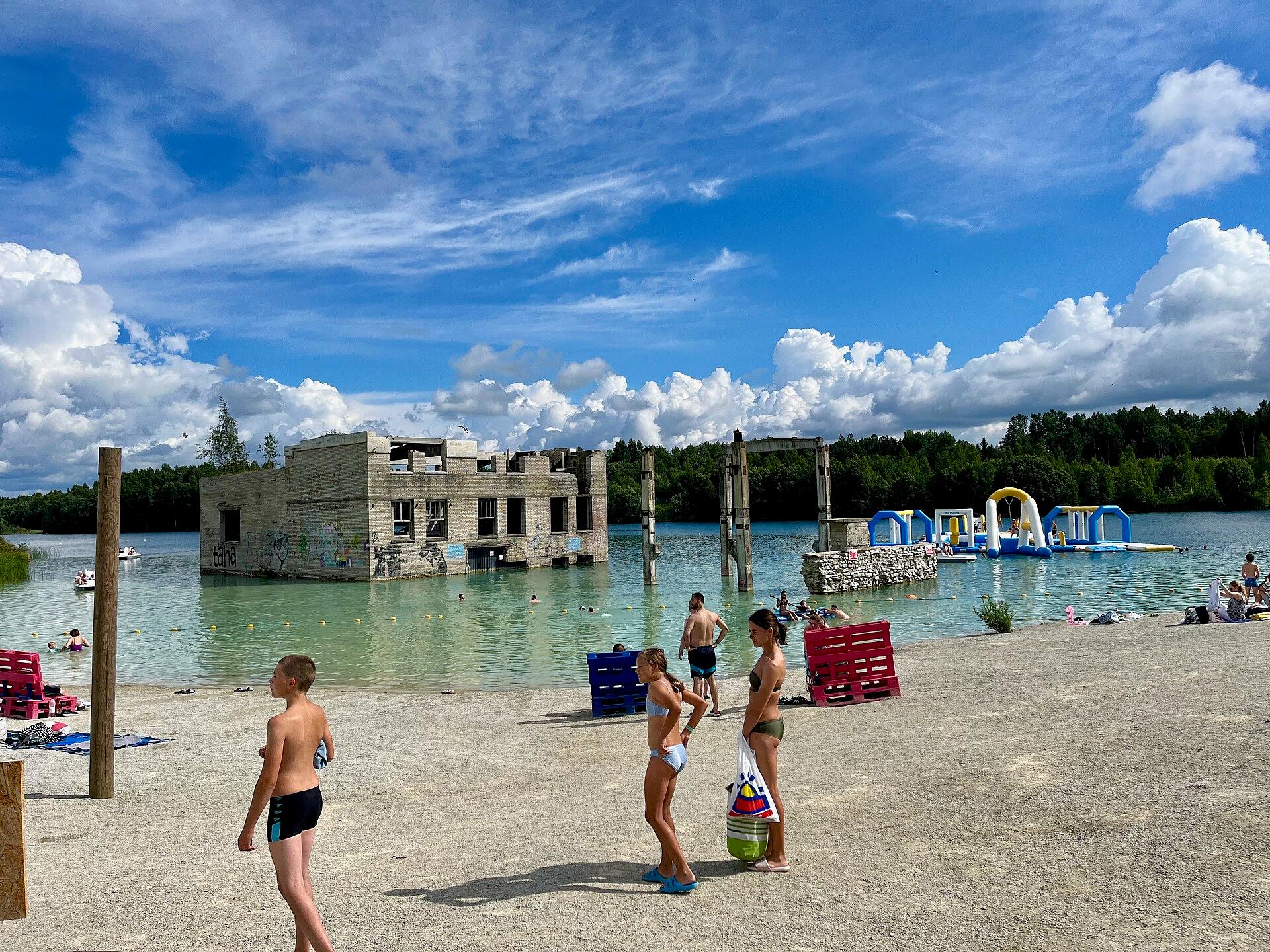

Rummu Quarry is one of Estonia's most photographed places: a former limestone quarry flooded with strikingly clear turquoise water, with the walls of an old Soviet-era prison on the shore and a pale spoil heap rising beside it. Below the surface you can still see submerged buildings, trees and machinery, which is why divers and snorkellers love it.
The quarry is in the small settlement of Rummu in western Harju County, about 40 minutes by car from Tallinn according to the site's official website. The nearest town is Keila, roughly 13 km away along the Haapsalu road.
Before you go, know this: Rummu is private land with paid entry. You buy a ticket at the gate, swimming and climbing the hill are at your own risk, and the derelict buildings are off limits. The details are below.
History
Rummu was a limestone quarry. Part of the stone was the marble-like Vasalemma limestone, sometimes sold as "Vasalemma marble", and geologists treat the exposed rock here as the reference section for that layer.
Quarrying started in 1938 with the Vasalemma lime and marble works. During the Soviet period, prisoners from the nearby Murru and Rummu prisons did the digging and stone processing. The pit only stayed dry because water was pumped out constantly. When pumping stopped in the 1990s, groundwater rose and filled the quarry, swallowing workshops, parts of the prison grounds, equipment and trees.
The quarry is about 2.5 km long and up to 750 m wide, and the lake that formed in it covers about 88 hectares. The pale hill next to it is a heap of quarry waste rock, locally called the "ash hill", its slopes carved into deep gullies by erosion. Murru prison closed for good at the end of 2012.
For years after that, Rummu was an unofficial swimming spot with little supervision, and there were serious accidents, mostly from people jumping off the ruins. Today the area is fenced and run by a private company that charges admission and maintains facilities.
What to do
According to the official Rummu website, you can currently:
- Swim from the beach on the quarry lake (at your own risk; there is no lifeguarded beach);
- Dive and snorkel around the submerged buildings;
- Hike up the spoil heap for views over the lake and the prison (also at your own risk);
- Play disc golf on the course within the grounds;
- In summer, rent pedal boats, SUP boards and rowing boats, or use the inflatable water park;
- Visit the Murru Prison Museum with an audio guide or a pre-booked guided tour;
- Eat at the lakeside café, stay at the caravan park or tent area, or book accommodation on site.
Diving at Rummu
Diving is run by Rummu Diving, a PADI five-star dive centre on site. Beginners can do an introductory dive with an instructor (from age 12, according to the centre), certified divers can join guided dives or take courses, and there are guided snorkelling tours with all the gear. Dives must be booked in advance. In summer 2026 there was even an underwater photo exhibition you could see while diving or snorkelling. Check schedules on the Rummu Diving website.
Murru Prison Museum
The museum covers prison cells, punishment areas, workshops and utility rooms, plus the surrounding grounds. The audio guide runs on your own phone, so bring a charged battery and mobile data. According to the official website, it is available in Estonian, English, Russian, German, Finnish and Latvian. Guided tours are offered in Estonian, English, Russian and Latvian; they are for groups and need to be booked in advance. Stay within the areas covered by the tour, since most of the buildings are in poor condition.
Getting there
Rummu Quarry is at km 13 of the Keila–Haapsalu road (address: Haapsalu mnt 13, Rummu). You will see the prison walls from the road, and signs point to the entrance.
- By car: Head west from Tallinn towards Keila, then follow the Haapsalu road. Park only in the marked parking areas, never on the beach or along the main road.
- By public transport: Buses run from Tallinn towards Rummu, and Elron trains on the Turba line stop at Vasalemma, a few kilometres away. Check current timetables at peatus.ee or elron.ee.
- By bike: Rummu combines well with a ride around Padise and Vasalemma.
Rummu is at the opposite end of the country from Narva and Ida-Virumaa, so it works best as a day trip from Tallinn.
Tickets are sold at the gate (or the ticket kiosk in season). Your day ticket is a wristband that lets you leave and come back the same day. Outside the main season (September to May) entry is through a turnstile and only card payment is accepted. Prices and opening times change by season, so check the official tickets page before you travel.
Safety and rules
Rummu's rules have changed a lot over the years. It used to be freely accessible; now it is a ticketed private site. The official terms include:
- A ticket is required to enter the area, and you need to keep your wristband on until you leave.
- Swimming and climbing the hill are strictly at your own risk. The official information does not mention lifeguards.
- Entering buildings is forbidden unless they are part of a guided tour, the café or the water park. Most structures are derelict and dangerous.
- Children and pets are their guardians' responsibility. Staff suggest writing a parent's phone number on a child's wristband.
- Drones: before flying, you must contact the nearby Ämari air base and check the airspace map.
- Commercial photography and filming require prior permission from the management.
- Change clothes only in the changing booths, put rubbish in the bins, and do not damage anything on site.
Beyond the official rules: the lake bed is littered with concrete, rebar, scrap metal and barbed wire. Jumping in from the ruins or high banks is genuinely dangerous, and people have been badly hurt doing it. The water stays cold even in summer and the shore drops off steeply, so keep a close eye on weaker swimmers. The slopes of the spoil heap are steep and crumbly, especially after rain.
Conditions can change from one season to the next, so check the current rules on the official website before you go.
Best time to visit
July and August are best for swimming and water activities, when the lake is at its warmest and the summer rentals are open. Weekday mornings are the quietest. In spring and autumn the site is calmer and the water is often especially clear, which suits photographers and experienced divers. In winter the area is open in off-season mode, but walking on the ice is risky and is not listed as an activity.
Nearby
- Padise Abbey, the ruins of a medieval Cistercian monastery, is only a few kilometres away and fits easily into the same day.
- Vasalemma Manor, a neo-Gothic manor house now used as a school, is on the way from Tallinn.
- If Rummu sparks an interest in Estonia's mining past, head east to the Kohtla mining museum, where you can go into a real underground oil shale mine.
More about Estonia's quarries and mines is on our English homepage.
Frequently asked questions
Can you swim in Rummu quarry?
Yes, there is a beach on the quarry lake, but under the official terms swimming is strictly at your own risk. Entering buildings or ruins that are not part of the guided tours, the café or the waterpark is forbidden.
Can you dive at Rummu?
Yes, diving and snorkelling are run on site by Rummu Diving, and every dive must be registered in advance. The introductory dive with an instructor is suitable from the age of 12, and certified divers can arrange to dive on their own with a buddy during the centre's opening hours.
Is there an entrance fee?
Yes, the site is private and you need a ticket, which is given as a wristband and is valid for one day. You can choose between a quarry ticket and a quarry plus prison museum ticket, small children enter free, and current prices are on the official ticket page.
Is there an English tour of the prison museum?
Yes, the audio guide, which runs on your own phone, is available in English among other languages. Guided tours are also offered in English, but they must be pre-booked.
Where can I park?
Only in the designated parking areas, which according to the official information are free but unattended; parking on the beach is not allowed. If you have not paid for an overnight stay, you must drive out before the gate closes, otherwise an overnight parking fee applies.
Can you visit Rummu in winter?
Yes, in the off-season from September to May you enter through a mechanical gate and tickets can only be paid by card. The off-season ticket covers both the quarry and the prison museum.
Is there somewhere to eat?
Yes, there is a café by the beach serving drinks, ice cream and food. In season, cash and cards are accepted at the gate, the prison museum, the café and the waterpark.
Can I fly a drone?
Only after checking first, because the quarry is close to Ämari air base: you must contact the Ämari airfield and check the airspace map before flying. Commercial photography and filming also require prior permission from the management.